Theses on Technology

I
The present moment asks us an unavoidable question: why, after a century of some of the most rapid technological transformations of human society, are we witnessing what amounts to the complete halt of technological progress?
The notion of technological progress is meant to express two distinct trends. The first is the development of wholly new technologies which usher in radically new modes of human existence and fundamentally reshaping the technical landscape. The second is the successive refinement of existing technologies in such a way that these later iterations are orders of magnitude more capable of performing their designated tasks which, in turn, is supposed to accelerate the overall efficiency of a given technical system.
The last decades have at best been defined by the second, iterative mode of technical development. While the vast majority of patents have always amounted to rather trivial modifications of existing technologies, the possibility of a complete technological upheaval presents itself as being more likely to manifest as a widespread collapse of the existing planetary technological infrastructure rather than being a realization of our loftiest techno-utopian visions. Those who still adhere to such ideals are more often than not the target of derision and mockery, being seen by all but the most ardent defenders of the aesthetic ideals of the early 20th century as little more than gullible fools being strung along by morally dubious hype men.
A general feeling of malaise and stagnation frequently gives way to the feeling that the technologies of the future, far from emancipating human beings from their conditions or unlocking latent human potentials, are nothing more than new forms of domination and extraction. Yet this shift in mindset is quite sudden in the grand scheme of things. At the turn of the millennium—and even as late as the 2010s—the echoing reverberations of prior centuries were enough to keep the illusion of progress afloat.
The longue durée of modern technical innovation culminated in the final spasmodic paroxysms of computational technologies; the final retreat from technology as object to technology as the management of information. Computation, as a necessary precondition for the development of cyberspace and its subsequent management, opens a Pandora’s box of unchecked semantic complexity while trying to domesticate it through the collection (or, the preferred term, harvesting) of massive data streams. In this regard, the proliferation of Large Language Models (LLMs) is the inevitable consequence of a certain degree of system complexity: the accumulation of information rapidly becomes useless without a similarly technical means of mediating it for human observers.
Downstream effects of this particular technical assemblage are felt most immediately on the new technologies of the body which were developed as the human organism itself becomes rendered as if it were information alone. The mapping of the human genome and the rapid development of genomic technologies is but one example among many, and similar scientific excursions into the study of the brain through neural imaging were predicated on the ability for computational models to be made and deployed onto living beings. And, as with all technical regimes before it, this ascends to an ontological mode in which simulation and computation is taken not as a map of the real, but a description of the territory itself.
Crucially, the promises of these various technologies remain largely unfulfilled. The Internet, far from ushering in a free and democratic world through the unchecked flow of information, instead has coalesced into a highly centralized and tightly regimented data collection apparatus. Neurological technologies, far from enhancing human cognitive capacities, instead oversee a period of rapidly declining mental acuity, with even basic reading and math skills being at far lower levels than they were in past decades. Without a doubt, biomedical technologies have seen the most genuinely innovative applications, but they are nevertheless mired in a healthcare model overburdened by its own complexity. The grandiose promises of custom-tailored medicine and the elimination of disease have been quietly shuffled away as life expectancies continue to slowly decline.
The aforementioned techno-pessimism is both warranted and indicative of the ideological collapse that the 20th century wrought upon itself. As the naive assumptions of linear progress and unchecked technological potential gave way to a set of very real constraints, the question is not if the halting of technological progress happened—this is unquestionable—but rather why such a shift occurred. This I take to be a still open question, though one which may potentially be answered in the near future.
Two different kinds of answers seem available to us. One sort is broadly construed as sociological; the other, ontological.
A sociological explanation points to some underlying extra-technical force or social condition as the cause for technological stagnation. We can use a vaguely Marxist example for illustrative purposes. The technological development of the 20th century, especially in its latter half, was driven first and foremost by security concerns as competition among the global great powers necessitated greater and greater resource commitments. That most major technological innovations at this time were essentially civilian applications of military technologies—from airplanes to the Internet—is not coincidental, and the shift away from industrial manufacturing toward information technologies represents the transformation of capital from a productive mode to an almost entirely financialized form. The fall of the Soviet bloc meant that the material conditions which gave rise to the technological arms race were now gone and, in the absence of a genuine peer competitor, Western technology had no material impetus aside from the accumulation of capital. As such, neoliberalism replaces the centralized planning of the state and the possibility of genuine technological innovation grinds to a halt.
The ontological account, on the other hand, emphasizes the hard physical limits which were reached in the 20th century and the inability for the present technical paradigm to engineer its way around these limits. Much of what exists between quarks and the Planck length is a complete mystery, even within the speculative domain of theoretical physics, and some of the most basic cosmological questions, such as the age of the cosmos or the rate of cosmic expansion, have yet to be convincingly resolved. While these are of almost purely scientific concern, they nevertheless illustrate that the optimism characterizing prior ages has given way to the uncomfortable feeling that the world begins to fray at the seams when we investigate it in enough detail. Rather than being a harmonious or carefully designed system, the world itself seems to evade coherence and human understanding at every turn. Here, technology can only progress insofar as new discoveries can be made: the technological halt is essentially downstream of a much more fundamental scientific deadlock.
The easy discoveries have already been made and the low-hanging technological fruits have already been plucked. The cost of discovery is measured not in human ingenuity, but energy expenditure. The possibility that we have exhausted the bulk of scientific and technical innovation because of the limits of the Earth, rather than a failure of social or political willpower, means that the only possibility of recreating the technological boom of prior centuries would entail a radical transcendence of terrestriality itself.
These explanations certainly are not incompatible, but they do fundamentally diverge in regards to the causal story. Assuming a purely sociological explanation, there should be no inherent barrier to resume technological innovation aside from a reallocation of resources (or, assuming a more systematic crisis, a complete reorganization of academia, industry, and the state). The future may in fact reveal this to be the case if countries outside of the Western sphere, such as China, are able to be a source of technical reinvigoration. The sociological explanation therefore carries within itself a seed of optimism: social transformation may be the only required catalyst for not just a human use of technology, but the fulfilment of the greatest promises of the past’s emancipatory dreams.
The ontological explanation, however, is more peculiar and leaves us in a more uncomfortable situation. It carries with it a mark of extreme arbitrariness: at this particular moment in human history (and no other!) have we finally run up against the barriers placed upon us by nature. We can no longer innovate our way out of our conditions because these conditions are not merely particular configurations of a terrestrial nature, but inherent in reality itself. If technical innovation is from here onward impossible, in a capitalist paradigm the only trajectory of technology is to be further subsumed into the domain of financialized speculation.
In that regard, I have my suspicions that, even if it is not the sole reason for the current situation, this ontological dilemma may be the root cause. The physical barriers imposed upon us do seem to be quite real and the planet we inhabit has an ostensibly finite resource supply which is being exploited to a point where, if knowledge of our existing technologies were lost, we would have no ability to restart the industrial revolution.
We exist at an inflection point where the trajectories of the 19th and 20th centuries have completely exhausted themselves. Scientific and technological progress cannot continue precisely because this “progress” was revealed to be nothing more than the successive unfolding of a particular ideological paradigm that has now reached its conceptual limits. With the clarity of retrospect, we can see now that the lofty visions of lost futures were, in fact, the projection of the time’s ostensibly aesthetic sensibilities onto a technical substrate.
That is to say, the stagnation of the present is the inevitable result of trajectories birthed in past centuries. That it culminated in the present moment is neither coincidental nor particularly avoidable, marking the possibility of a rejuvenation of the past’s pace of technological development as a foregone conclusion. Let the dead bury the dead.
The door to the future consists in the radical transformation of social relations and, as in all eras, comes with an accompanying reconfiguration of our conceptual scheme. The notion of a cosmos—a unified or otherwise orderly world whose hidden structures will be progressively revealed to us—gives way to a disorderly, acosmic universe in which the boundaries of human knowledge reveal a world whose topography is fundamentally incompatible with our guiding anthropic assumptions. Similarly, when shorn of the notion of progress, the technical object can finally be reclaimed as something which is of a primarily aesthetic concern—a feature which has always been present but is nevertheless presently occulted—and technological transformation itself is finally understood not as the deployment of a human craft impulse, but instead as something emerging from the core of the technical object itself.
II
The transition from antiquity to modernity can be understood as a shift from a conception of machines in terms of unity to that of motion.
In the ancient conception, technical objects—a class containing both mechanical contraptions as well as aesthetic objects—were ontologically inferior to living beings. Trapped in a double-bind of being both causally derivative and compositionally inferior, technical objects took their existence from living things as an imitation of them, but in virtue of being made by human hands they could never rise to the level of unity possessed by natural objects. The soul of living beings was a source of unity which established the organic body as a fundamental constituent of reality while the technical object was a mere aggregate of parts.
Substance, in Aristotle’s conception, is at core a question of the relationship between parts and wholes. For true substances, parts are only parts in potentiality: what is ontologically real is the (hylomorphic) unity and the parts only become discrete objects upon their separation from the whole. Technical objects, unlike living things, possess parts which are fully actual as discrete things. Hence their ontological inferiority.
Life, conceived in this manner, is organic insofar as the organ is taken to be the tool of the organism, the means by which the whole being is able to employ some power that ultimately derives its reality from the soul. Technical objects are external organs: tools by which the soul is able to deploy its inner powers onto the field of reality. In this schema, there is no real possibility of technical innovation, but rather technological development is understood in terms of the rediscovery of a power of the soul which was, at least in some imagined past, concrete and actual at some point.
Because modern philosophy no longer conceived of natural beings in primarily compositional terms and instead sought an explanation in the domain of kinetics, natural teleology was preserved at the cost of subsuming the organism under the conceptual domain of machines. The Aristotelian cosmos, which consisted of a nested configuration of organized wholes, gave way to one of bodies and motions. While this did not preclude the possibility of seeing the whole of nature as a unified totality (Spinoza) or preserving an incorporeal unifying principle for the bodily aggregate (Leibniz) within that conceptual mode, it nevertheless displaced the core investigative endeavor of natural philosophy from metaphysics to physics. Design no longer signified the imminent generative presence of a World Soul, but instead became the means by which divine transcendence could be secured. God now worked upon the world like a watchmaker.
At the level of the individual organism and its parts, bodily motions were understood in terms of functionality. The sense of organ as tool was retained in some sense—that it was comparable to a technical object for, at minimum, explanatory purposes—but could no longer be primarily understood as an implement of the body. Since the parts of living beings were no longer intrinsic constituents or expressions of the soul’s various potencies, but instead occupied functional roles, the epistemological gap between the model or machine and the living organism vanished. The lungs were, in a peculiar and somewhat literal sense, wind bellows. The eyes, lenses, and so on.
As a matter of knowledge production, modern science was able to gain access into the nature of things by shifting its investigation from situated, organic life into the laboratory. Laboratory life is deliberately engineered as a space of isolation, one in which natural complexity gives way to predictable and determinate patterns. The technical object, being the model for all motions and the conditions by which knowledge of these motions can be attained, is thus transformed from a defective imitation of nature to a microcosmic image of nature itself. And since there is no inherent difference between organic and artificial motions, the inner life of the living being no longer requires any sort of animating soul to be the first cause of motion. Rather, life itself becomes subsumed into a broader series of corporeal motions proceeding from its primordial divine impetus.
This conception of nature—deterministic, mechanical, and essentially kinetic—remains a commonplace view, both for those who serve as champions of modernity and its staunchest critics. The reactionary response to modernity is invariably a desire to return to the conceptual primacy of the organic and one which advances, usually on moral grounds, a critique of scientific methods as innately opposed to the possibility of an authentically organic form of human life. As such, this criticism of modernity is always a veiled criticism of technology itself and, rather than being able to effectively combat its opponent, remains mired in complete and total futility insofar as it considers essentially technical concerns as if they were conceptual delusions or moral failures.
More importantly, however, these people are quarrelling over a territory which no longer exists. The assumption that science in its current iteration (or even inherently) relies on a deterministic and mechanistic conception of reality is a fiction conjured up for polemical means, yet nevertheless is treated as if it were some profound and essential doctrine. The idea that a harmonious and organic conception of nature was replaced with a cold, calculating, and exploitative mechanism entirely occults the actual underlying motivation at stake in science’s origins: to preserve an essentially theological commitment to an ordered and teleological cosmos without having to rely on the empirically disproven keystones of Aristotelian incorporeal movers and incorruptible celestial bodies.
The through-line in both the ancient and modern conceptions of nature is teleology. The deployment of the craft analogy, found consistently in both periods, serves as the lynchpin for cosmic purposiveness. The inversion of priority in modernity that places the technical object as the focal instance of natural motion is certainly unusual by ancient standards, but was certainly not a completely new innovation nor is it something that was unique to the European Enlightenment. If anything, there seems to be a strong tendency for people to take their artifacts as microcosms of the entire cosmos and the deployment of new technologies of all sorts seems to result in accompanying cosmological reconfigurations.
What exists in the wake of modernity is a somewhat confused landscape, but one which has largely moved beyond the mechanical and teleological assumptions which had their death throes in the 20th century. The present moment can be understood as finally coming to terms with the end of both machines and the organism, having replaced both with the concept of the dynamic system.
The benefit of system-thinking is that it prioritizes neither organism nor machine, but proceeds from an abstraction which subsumes both natural and artificial under the domain of nebulous and ever shifting energies. Systems exist within an energetic topology and the flows of energy from one region to another proceeds without any need for teleological assumptions. This is perhaps its greatest strength and while there should be some reservations about granting priority to abstractions that purport to be independent of any concrete particular, the conceptual innovation here cannot be ignored.
The dilemma confronting the present moment is, in essence, whether the system of things is closed or open. That is to say, whether the whole exists as a genuine totality—a position which ultimately returns us back to the pre-modern conceptual schema—or only as a conceptual aggregate of really distinct parts. If the latter, the conceptual rebound signals the final act of some of our most deeply held anthropic assumptions which, upon being revealed as the spiritual conjurations of a crafty ape, vaporize as they escape into the realm of pure faith.
III
The human adoption of technology does not proceed in a linear fashion because technology does not proceed in an unfolding succession. Technical objects come to be at the meeting point of life and world, human and environment. Technical objects, once generated, present themselves as quasi-eternal beings—gifts given from gods or culture heroes in a deep but nevertheless immediately felt past—whose place within the productive process cannot be done away with.
This is not an inevitability, however. Minor technologies can fail to gain a foothold, being outcompeted in their functional niche by existing objects or human methods. Certain technical assemblages run into their functional limits in which they cannot further spread on their own accord and need to be imposed by force. Technologies, even relatively ubiquitous ones like anthropogenic fire or the bow and arrow, can be lost to the sands of time.
The present situation is one in which our entire technical assemblage could not survive a widespread systemic crisis, yet nevertheless presents itself as if it were an unshakable law of reality. The planetary work machine chugs on relentlessly toward its own annihilation.
IV
The strongest bastion of a decrepit humanism is the belief that all technological relations are actually occulted human relations.
This line of thinking proceeds from the example of the Mechanical Turk: a chess-playing machine that appeared to move the pieces autonomously, but was in actuality controlled by a human being hidden inside a cavity in the machine. The appearance of the freely acting machine is only a surface level effect concealing what is, in reality, a simple mask for incontestably human agency. All technological agency is reducible to human agency, all machinic effects proceed from ostensibly human hands.
Within this mode of thinking, two distinct claims must be distinguished. The first is that there are, in fact, no uniquely technological qualities except insofar as they are diminutions or transformations of primordially human qualities. The artificial–natural divide can only be drawn at the boundary of the human, with all artifice being contained within a broader human lifeworld. The second claim rests on the conception of technology as instrument. Technical objects are mute and passive, waiting to be animated by a particular human agent and directed toward a distinct purpose. The assumption that the actuality of an instrument can only be achieved through human intervention is one which is based on the belief that technical objects exist exclusively as use objects.
While the inverse claim—that all human relations are in reality technological relations—is one which invites profound theological speculation, it is an unnecessary overcorrection of the humanist error which rests on equally untenable assumptions about the nature of technical objects. Rather, the more modest claim—that at least some technological relations are irreducible to any non-technical origin—proceeds from the position that there is, in fact, a form of agency unique to machinic existence. This agency is ontologically distinct from human agency, both in scope and content, and is present in virtue of the real constitution of the machine configuration itself.
If there is such a thing as machinic agency, even radically distinct from all otherwise familiar forms, then the expansion of a complex technical system runs the possibility of being initiated by a distinctly nonhuman impetus. The advent of modernity on a planetary scale is a genuine rupture, a technical apparatus which far surpasses any prior craft assemblage, and raises the inescapable question of whether it is in fact the machine which rules over the lives of human beings.
V
Our primary conception of the artificial has long been that of the technical object, either as an ornamental object or as something which fulfills a utilitarian function.
In the name itself, “artificial,” contains the sense of artifice, a human contrivance made as the product of some technical skill. The Latin artifex is a craftsman as well as a schemer or actor; ars denotes both handicraft and fraud. Greek techne has a similar double-meaning, being both a craft or skill as well as some sort of cunning or guile. The concept of the artificial therefore is inextricably tied up with a notion of craftsmanship—intentional and skillful generation of an object whose existence aims to fulfill some human need—as well as being a deceptive imitation of an otherwise pure and primordial nature.
The role of the craftsman in antiquity was often sacralized. The craftsman was the one who shaped the stones which would become the divine form present among the people, a living participant in the eternal dance in which divinities created the world. God was the perfect craftsman, the worker whose labor was everlasting and complete.
As the guild-hall was annihilated in favor of the assembly-line, a similar transformation occurred in the concept of the artificial. The production process, shorn of its human character, became understood through that of the machine. Artificial temporality was conceived of as processes of identical (atemporal) repetition that proceeds with a cold indifference and materialism, proceeding from this mechanical conception, encountered the same indifference on a cosmic scale. As technology further spread throughout the corners of the Earth—and into the heavens—the fear became that mankind, rather than functioning as masters of the machine, was to be subsumed into it.
Modernity, insofar as it continually fails to go beyond the conceptual foundations laid for it by antiquity, remains committed to an essentially anthropic conception of technology—one which is conceived primarily in reference to the tool as use object.
The conditions of our present moment demand a reconsideration of this assumption. With the advent of geoengineering and genetic manipulation, the previously clear boundary between natural and artificial was dispersed into the landscape itself. The artificial pervades the natural. We live in a geological moment where our very presence on this planet manifests as a pervasive distribution of microscopic waste. The presence of humanity in nature is marked not by grand contraptions or endless urban sprawl, but in the proliferation of a distinct signature of irreducibly artificial residues.
Insofar as we continue to conceive of artificiality in teleological terms, these residues will be seen as a kind of ontological aberration, something which fails to rise to even the shadowy and parodic pseudo-substantiality of the craft object. Yet these residues are nevertheless as fully artificial as any craft object, making their ontological marginalization attributable not to any innate feature but rather the anthropic assumption that the artificial exists as such for human beings. That residues are not only useless, but exceptionally so, serves to demonstrate the inherent autonomy of the technical object; its existence is not reducible to any particular mode of human utilization.
Shifting the focal instance from the craft object to material residue is a shift from a tool ontology to a trash ontology. The mark of the artificial consists not in the deployment of matter for human ends, but rather the proliferation of wholly new modes of being which are marked precisely by their inability to be fully subsumed within a natural register. In tool-thinking, engineering in the essential scientific mode; in trash-thinking it is archeology, a field which is in essence a fastidious sorting of the extravagant stratigraphies of human waste.

VI
All metabolic processes are governed by the circulation of heat. Accordingly, in both organic and artificial systems, the primary concern is that of heat leakage.
The energetic dispersion of the sun is the precondition for all life, all language, all civilization. Heat and life were seen as essentially the same in antiquity; the vital heat of the organism was the inner spark with which it was able to constitute itself. That the heavenly bodies themselves were a kind of pure fire was only confirmation that our terrestrial existence, being a mere imitation of a cosmic paradigm, was driven by the same thermic impetus as the rest of the universe—an impulse which essentially culminates in Stoic physics in which all things are powered by the residual traces of protocosmic pneumatic body.
Bataille was right: all civilization is nothing more than the condensation of heat. The technical object, insofar as it is reliant upon organic fabrication, is too. Yet unlike organic systems, technical systems are much more immediately convertible into a calculus of energetic expenditure (in no small part because our method of calculating energy emerged out of an essentially mechanical conception in the Early Modern period).
Technological decay, being the result of a particular technical object reaching the completion of its own operation, is an imminent process rather than an external one. That is to say, the machine remains prior to temporality insofar as it is not being deployed as a machine. Insofar as its operation inherently results in the transfer of heat—thermic energy—outside of the closed system of the machine, technological systems have the same tendency to disperse back into their constituent elements as organic ones. What distinguishes them is that the organic system recycles itself while the technical ones reiterates itself; what is preserved as a residual trace of organicity is incidental while, in the case of the technical, is essential.
The puzzle of the current moment is that technological decay seems to be progressing at a rate which outstrips the typical “input–output” operation of thermic transference. The previous tendency was to “do more with less,” a particular sense of efficiency grounded in an understanding of minimizing waste. The current tendency, however, bears the mark of systems collapse: ever-increasing expenditures of energy for diminishing returns.
As such, the deployment of exceptionally energetically intense yet socially useless technologies can be seen as a sign that the previously tight and coherent system of technology has a major issue: heat is leaking out and we don’t know where it’s going.
VII
Science is the study of the nature of things. Technical objects, insofar as they possess a determinate and fixed tendency, are subjects of science. The same is true for human beings. Insofar as they step outside the bounds of nature by operating on their own accord, they outstrip the possibility of scientific study.
The autonomous machine has primarily been studied as a theological artifact—the dwelling of an interior spirit or divinity—rather than a technical one. The same is true in the case of the aesthetic object which, given its sensuous and ornamental appearance, creates the illusion of having an existence for us.
In both cases, the true nature of the technical object lies not in it as it is experienced, but as it outstrips experience. Rather than searching for the divinity or beauty of the agalma in the structure of experience, a truly scientific approach to technical objects will find the god within the object itself.
VIII
The technological uncanny consists in the experience of the technical object as possessing some inner life beyond that of mere instrumental use. The uncanniness is like the curvature of a reflective surface: the humanity of the observer is made monstrous in the encounter with the technical object.
The technical Outside, therefore, is the transference of this phenomenological encounter to the ontological realm; the machine embodies something from outside the human ken. The world of the technical object is a space of radical alterity which only presents itself in a familiar guise.
The Outside, in its most concrete instantiation, consists in the self-replication of the planetary work machine as it acts according to its own laws. Thaumata-Autokrator. Under this regime, the basic struggle of humanity consists in the resistance to its own domestication.
IX
The conceptual failure of “transhumanism” as an ideological constellation consists in its presupposition of an inherent and immutable opposition of the technological and the human. Nature is something to be transcended and escaped from and, accordingly, the human subject is but the final stage of a trajectory which culminates in the technological suspension of nature itself.
The double-bind faced by transhumanism is that it places an intractable burden upon the same human subject it seeks to transcend. Insofar as the human organism is nature’s most feeble of accretions, it is the form whose entire essence must be emptied of determinate content in order for its true potential to be fulfilled. The purification of the subject is conceived of a progressive annihilation of corporeality and the winnowing away of animal impulses which, in a move evocative of its antiquated metaphysical underpinnings, is the precondition for a totally rational and free being.
Yet the goal being sought can only be reached through this same subjectivity that must annihilate itself. (A similar dilemma is faced by the Marxist who holds that the emancipatory activity of the proletarian class is simultaneously the real conditions of its own abolition.) Going beyond the human is essentially a going through the human, as transhumanist messianism seeks its liberation through ostensibly artificial, rather than spiritual means. The human subject is Baron Munchausen pulling himself out of the mud by his own bootstraps, a well which produces a pure drink despite being marked with an inherent taint.
The transhumanist dream is essentially that of a subject whose concrete actuality exists completely independently from the conditions which gave rise to its own subjectivity, the Enlightenment dream of a fully self-determining subject. The rational core of transhumanism can only be preserved if this notion of a self-determining subject is replaced by a similar but distinct formulation of a self-constituting subject. This we shall call by the name of “Prometheanism.”
The basic conceptual distinction here can be understood as follows: transhumanism seeks perfection by going beyond the human, Prometheanism seeks perfection via the fulfillment of the human. Transhumanism understands the human organism as complete insofar as it is a natural object but incomplete insofar as it is a rational object. Prometheanism draws no such opposition between reason and nature; rather, nature is in itself unfinished and incomplete. So, while transhumanism conceives of its intervention into the natural order coming from outside of nature itself, Prometheanism is the immanent self-transformation of nature striving toward its own fulfillment.
Opposition to transhumanism is premised on the same grounds as transhumanism itself. Nature—the given—consists in a set of limits. While the transhumanist impulse is to see these as a mark of nature’s imperfections, its opponent places the imperfection in the human striving to overcome these limits. The boundaries of nature are given to us not as a prison, but as a scaffolding or a gift.
Prometheanism makes no such assumption. The limits of nature are not indelible marks of natural law but rather birth-pangs of a fundamentally unstable, protean world. Technology, rather than being an instrument which subsumes nature under human ends, is the catalyst for the realization of the unfinished project which is the human subject itself.
For both the transhumanist and its critics, humanity is fallen and must be redeemed; for the promethean, humanity as such does not yet exist.
X
The tendency of technology to provide access to the nature of things—the scientific application of technology—is constantly in tension with its tendency to obfuscate.
Because technical objects tend to rely on an in-built knowledge asymmetry to prevent unwanted access, there is a downstream tendency toward knowledge hoarding as a subset of technical knowledge. That is to say, the knowledge of the operation of technologies is something which is intentionally obfuscated in the form of a mediating interface as a means to securing exclusive access to a particular technical object.
In a somewhat naive yet generally well-intentioned impulse, the desire to remove these forms of mediation runs into the deeper problem of the technical architecture itself being inherently mediated and obscure. The affordances of certain design decisions are hard to undo and harder still to make accessible, so the cascading succession of technical developments often resembles a series of chance encounters and repeated failures, rather than any kind of linear progression of improvement and iteration.
As such, the technical object is constrained both by its inheritance—much in the same way as organic products of evolutionary histories—and the broader extra-technical incentives toward knowledge hoarding itself. Accordingly, most people encounter the technical object as an essentially alienating device.
Technology, taken in a pure and abstract mode, does not have to be something which mediates between world and user. This notion is one which had quite a large number of adherents in the 20th century in no small part due to the particular technical mode at play at the time, but the conceptual reliance on the “instrumentalist” understanding of technology can only hinder attempts at reaching a genuine and complete understanding.
Technologies of immediacy are technologies of freedom. The non-alienated mode of technical existence, the human agent, rather than conforming to the architectural confines of a particular technical inheritance, finds themselves newly able to project themselves out into the world itself in wholly new ways. Technology, rather than that which separates one from the world, can serve as the means by which one more fully enters into it.
XI
The Hippocratic corpus contains within it one of the earliest theories of technical knowledge: techne as that which is able to overcome even chance itself.
In the context of the early medical art, one which had an at-best inconsistently positive outcome, the skepticism toward these authors was warranted. Nature, rather than deliberate human intervention, was seen as the reliable means of attaining health, yet the technical expertise of these early medical authors had to be asserted for their practice to have any legitimacy. This, on one hand, was supposed to be expressed in their familiarity with the human body—understood as a sort of dynamic fluid system hovering within a narrow boundary of harmonious balance—and, on the other, was in their ability to “beat the odds” imposed on them by nature.
This basic postulate of the technical as that which overcomes chance was adopted both by Plato and Aristotle, serving as the fundamental distinction between genuine knowledge (epistime) and mere opinion (doxa). That something was arrived at by chance was a mark of its inadequacy, a sign that it was outside of the typical causal order which undergirded the whole of reality. As such, chance was relegated to a level below that of even mere contingency: while the contingent being could at least trace its reality back to some necessary principle, the product of chance owes its existence to nothing at all.
The development of technology, therefore, was largely understood in terms of the domestication of chance. Machine-like precision was understood as absolute reliability, though this particular assumption was largely downstream of technical timekeeping—a domain in which precision was meant as a tool to model sidereal rather than circadian time—and the expansion of this particular craft analogy to the technical domain as a whole was predicated on the certain assumption that chance only entered into the machine as an epistemic error rather than an ontological feature. Unsurprisingly, the clockwork universe had no ability to account for genuine freedom, as the classical world was at least able to accommodate freedom to necessity by understanding both as linked together in an organic process of self-constitution.
If materialism is to overcome the conceptual shackles it adopted in the 20th century, it fundamentally has to reconsider the determinacy of matter and return to the Epicurean view that matter, properly understood, was the seat of absolute spontaneity. Matter is both that which determines its own contours—by setting about the proper places for beings to come into existence—and the principle of motion by which natural changes are initiated. That is to say, matter, rather than being construed as the passive and determinate vehicle through which mathematical laws unfold over time, instead erupts into the causal order it itself establishes by freely breaking with its own kinetic tendencies. The key image of matter is not the mechanical contraption, but the solar conflagration or radioactive decay: matter as the unstable surplus which gives birth to order only under the auspices of time.
The logic of chance is the logic of the dice-game. The logic of spontaneity, however, is that of the swerve. As Lucretius understood, it is the freedom of things which grounds the spontaneity of matter, not the other way around; without the fetters of an overarching and transcendent order, all that is left is time and contingency.
Technology, insofar as it is able to establish a determinate possibility space, is subject to chance within that demarcation. Insofar as it is not, technology abides by the possibility spaces established for it, either in reference to a definite organic or metabolic process or in reference to the absolute contingency of matter itself (a contingency which outstrips the bounds of calculability, being essentially transfinite).
XII
Technical objects are Janus-faced; one side presents itself as a function of utility, the other as pure ornamentation. Both have equal claim to primordiality (even if the art object only truly comes into its own with the advent of behavioral modernity), existing prior to the advent of anatomically modern humans. As such, our technical inheritance from our hominid ancestors is one which never possessed a clearly demarcated boundary between the technical and the linguistic.
The relationship between technology and language is one of mutual co-constitution. Technological objects facilitate the spread of language by standing in place of the living subject and speaking on his or her behalf. The book (or webpage) is just the most recent iteration of the technical object’s intervention into language, serving as both the contours of the particular speaking modality and opening up new potentialities of communication. Crucially, insofar as the technical object is a utilitarian object its linguistic role is one of facilitation. Insofar as it is an ornamental object, it is (pre-)linguistic in and of itself.
For this distinction to hold, language proper has to possess some genuine difference from mere signaling, which is possessed by and emblematic of the whole of nonhuman nature. Signaling occurs at the cellular level as a sort of chemical cascade, with the beautiful harmonies of birdsong being nothing but the most rarified and subtle modulation of this truly antediluvian organic impulse. At a semantic or even grammatical level, signaling differs from language in terms of its complexity, but understood as a matter of degree makes a firm boundary difficult to establish. Rather, the boundary between the two consists in language’s escape from the concrete particular—the sign becomes an object in itself, a thing which exists in a heteronomous domain from that which it signifies. The contemporary fascination with so-called plant “language” is predicated on the intentional conflation of signaling with language, similar in many ways to the framing of DNA as the “language” or “code” of life itself. In both cases, the human conception of language encroaches upon what are fundamentally different modes of organic signaling and self-constitution, subsuming them within a quintessentially anthropic paradigm which grounds itself on vaguely moral sentiments instead of a genuine attempt to get to the basis of the phenomenon itself.
The technical object, expressed in its ornamental modality, is primarily linguistic and only secondarily aesthetic. The term aesthetic itself is a straightforward derivation from the Greek aisthesis, which refers not to an abstract conception of beauty but rather the mundane pleasures of sense-perception. As such, for language to constitute itself it must first be a delight to the senses, but the technical object’s role as signaling device precedes any such aesthetic concern. Primordial human language, as well as that of the technical object, consisted in the flight into abstraction that mere signaling is incapable of.
From this common starting point, the human organism and its technological accompaniments would diverge. While humanity becomes ensnared in language proper, the communicative domain of technical objects is best described as para-linguistic. Language permeates the technical just as much as the technical penetrates into the domain of language, yet the technical does not proceed in itself through language. Rather, the technical object is deployed as a vehicle by which language propagates itself in new forms.
The ornament, being always present as a form of signaling, speaks not for itself but its form nevertheless is the means by which its determinate content can be realized. The utilitarian object, conversely, proceeds via language only insofar as it operates in accord with the human, be it in the mode of the transmission of language itself (in a mediated form) or in the mode of its very constitution.
Insofar as the technical object cannot be reduced to either the utilitarian or ornamental mode—since both forms only gain their reality insofar as they are rooted in some human end—the technical object, conceived in itself, outstrips either linguistic mode. Yet it remains enmeshed in language, not as a linguistic object, but as the space along which language must traverse. As language migrates across the surface of the technical object, it encounters it not as a mute, empty vessel, but as something which transports it into a new register. This register dislocates language in space—bifurcating it along the line of division between presence and absence—and transmutes it in terms of its form.
This transmutation, achieved first in the mode of the maker’s mark, then in the record and balance sheet, and finally in its scriptural form, never fully shakes its magical origins as a puppet-like ventriloquism which animates the artifact with an uncanny human voice. It is through this ventriloquistic mode of the technical object which opens us up into the third side of the coin: the technical object as a sacralized object.
XIII
The advent of modernity was the transition of our species as a local, divided organism into an era of global computation.
This computation was one which was initially mediated entirely through mercantile technologies—double-entry bookkeeping, the silent trade, the ledger—all which stem from the accounting nature of logos as ratio. Cosmic justice can be instituted only over a finite domain; in an open system, the exchange relation replaces that of the balance-sheet.
Algorithmic computation, first developed for the astrological calculations of a Mesopotamian priestly caste, soon became the mode through which space itself was subsumed into a globalized work machine. The medieval world had Jerusalem at its center, with the three Old World continents radiating outward from it like leaves on a plant. The modern world, upon setting foot in the Americas, evacuated the center from the world in favor of capital. It should come as no surprise that a Polish priest, entering adulthood only a few years before the annihilation of the global center-point, would propose a heliocentric model that would eventually spread this same geospatial transformation on a cosmic scale.
The relationship of technology to space is akin to a gas being released into a vacuum. While the last major landmasses of the Earth were finally settled with the end of the Polynesian expansion into Aotearoa, the expansion of the planetary work machine into all corners of the globe was really only completed at the end of the 20th century. The old distinction between terra incognita and terra firma erodes as oceanic navigation transforms the mappa mundi into a model with cartographic precision.
The lands outside the power of the crown were inhabited by outlaws—those who were not subject to the law. Power is always tied up with the control of space, a tendency which is only amplified by technological means. The world used to be vast tracts of terra nullis; now, only a handful of inhospitable and uninhabited spaces hemmed in on all sides by the modern nation state.
Thinkers at the end of the millennium were fixed on this expansion of technology across space. Technology seemed destined to escape space itself, either in the form of interplanetary expeditions or in the deployment of digital technologies. Something was supposed to be accelerating, with the advent of the 21st century marking the moment where the speed of technology enters such a breakneck pace that humanity itself is either fundamentally transformed or cast aside in the techno-eschatological fervor.
And yet not only did this supposed acceleration fail to reach the glorious heights of its fever pitch, what was left in its wake was nothing more than stagnation. Global computing has had five centuries to escape territoriality altogether, but despite the advent of increasingly complex and technically impressive forms, we seem more tethered to the Earth than ever.
Does the Earth get the last laugh? Neither God nor Gaia seem ready to intervene, so what are we to make of the last five hundred years?
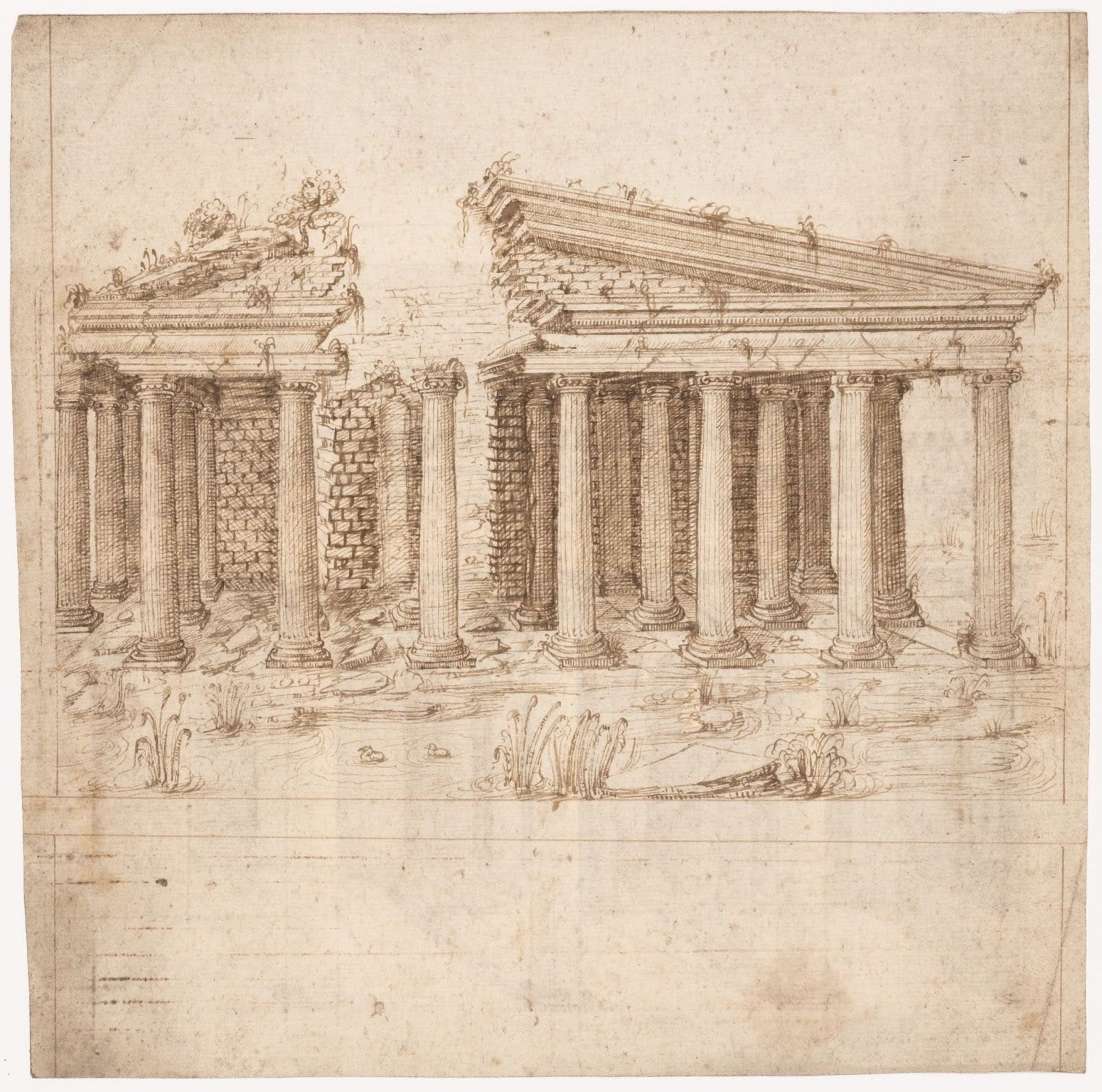
XIV
A proper—though perhaps not defining—feature of technology consists in its ability to transform the mixed substances of nature such that they generate a pure distillate. While this process inevitably is accompanied by a similarly pure yet nevertheless uncanny residue, the connection between technology and purity has, since modernity, been a dominant mode of thinking about the interrelation between the technical agent and natural patient. Nature, as an object worked upon by technical means, is purified of the accretions of chance as it becomes transmuted into an idealized instrument.
Alchemists long asserted that the products of their reactions did not just imitate, but replicate natural objects. Modern alchemy, in its most refined technical forms, transgresses this boundary even further, simultaneously perfecting natural object and, in doing so, generating something wholly alien.
The alchemist was, in a sense, the medieval materialist par excellence. That the products of alchemical reactions were not just imitations of natural things, but were the same as them, meant that the otherwise strictly delimited boundaries of the Scholastic cosmos were far more fungible and malleable than first appeared. Matter, rather than being an inert and shapeless substratum, instead was understood as an essentially polarized and energetic flux of continual self-transformation. As such, the alchemical ontology was one in which matter surged upward to higher and higher levels of reality, being capable of not just being the conditions of the organic lifeworld, but being itself the vital essence from which living things were actually constituted.
The concept of “purity” itself reeks of a normative, anthropocentric stench. On a purely constitutive level, purity consists in something undergoing a process of subtraction where the thing in question, stripped of its interrelated correlates, is presented within a state of material homogeneity. Yet unlike the Epicurean gods who, in virtue of their entirely pure atomic composition were able to subsist in the voids between worlds in pure and eternal tranquility, material purity is no longer the domain of abstract theological-ethical speculation. In fact, the ethical component of purity is now best understood as the subsumption of a material condition under the auspices of something entirely normative in nature.
As such, the purity of the artificial is simply one state-configuration among many; nature by no means universally selects for (or against) something in a pure state. The concept of matter developed by the Ionian Anaximenes understood this exactly: matter in its “pure” state was called by the name of air, but its transformations were a series of progressive foldings and unfoldings which it condensed or rarified into different material states. Matter is a spectral dimension spanning from the heaviest clods of earth to the most sublime exhalations of cosmic fire. Yet what defines matter is not the particular mode of its existence but, rather, the orderliness and regularity of its transformations.
Technology exists not to subsume these transformations into a distinctive domain, but rather rides upon the surface of matter, accompanying it along its unfolding iterations. Insofar as technology intervenes into matter, it does so as a mode of material transformation—technology never operates from outside of the material, no matter how much it tries to escape into anthropic abstraction—and the resulting forms of material purity are exceptionally condensed instances of a particular process of change.
Purity as the goal of alchemical transformation was supposed to be the material attainment of godliness. Now, in the modern technical complex, the attainment of new pure forms results in material with radically unstable energetic configurations—modes of being which can only subsist at microtemporal intervals. Technology, rather than bringing matter into contact with a transcendent divinity, now attains its completion in the realm of pure spontaneity.
Images
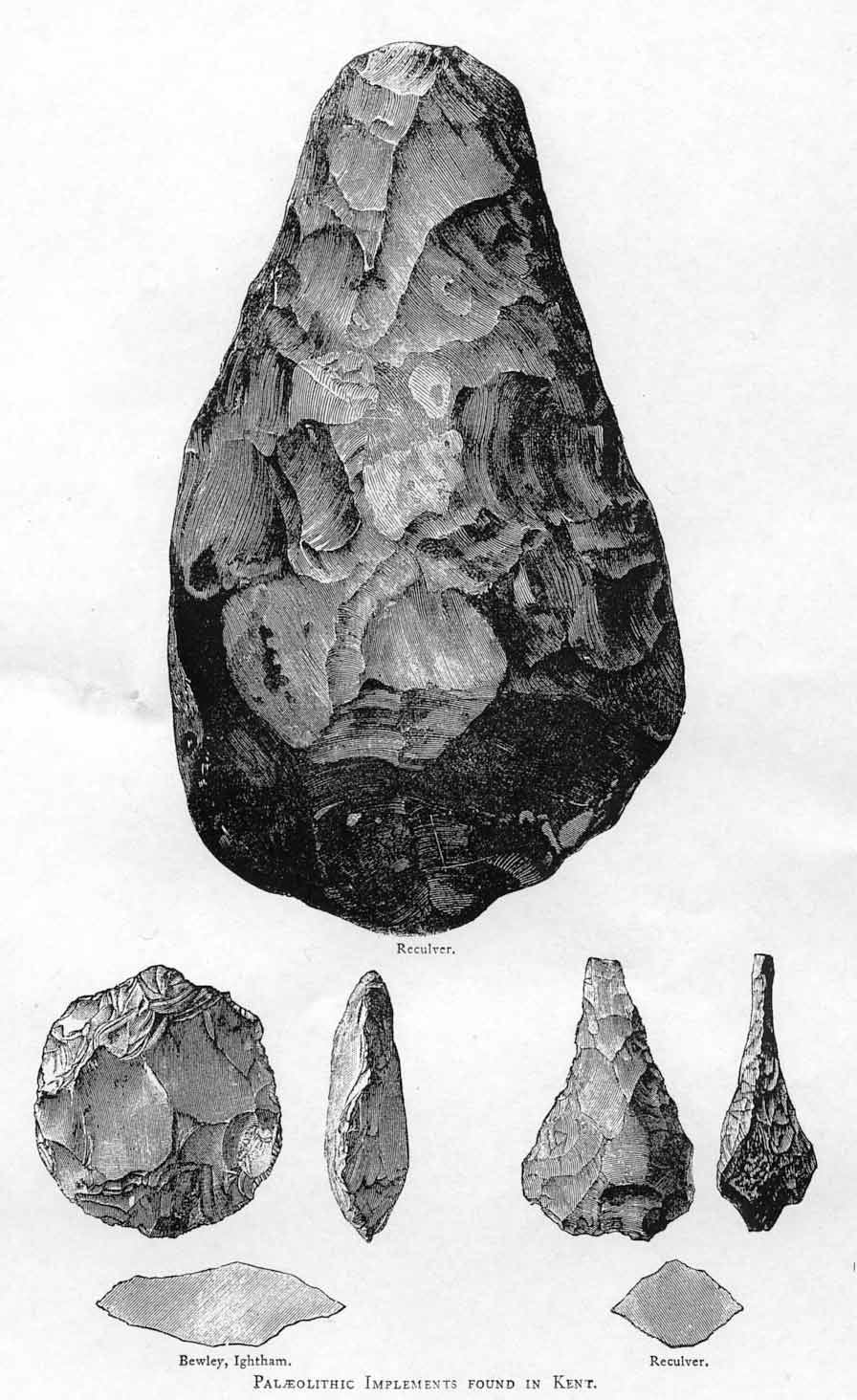
I: Acheulean handaxes from Kent.

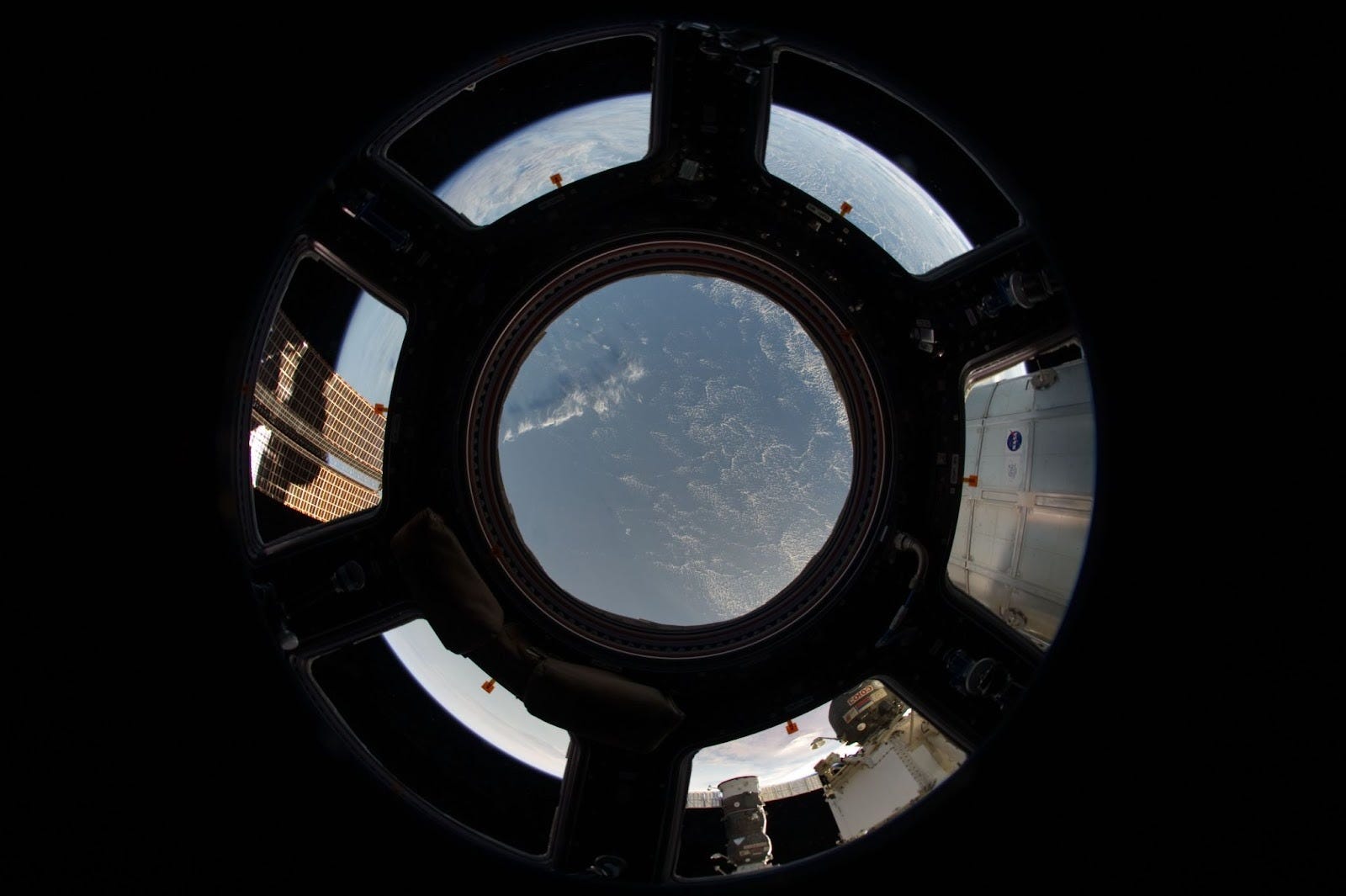
II: View of Earth taken during ISS Expedition 30.

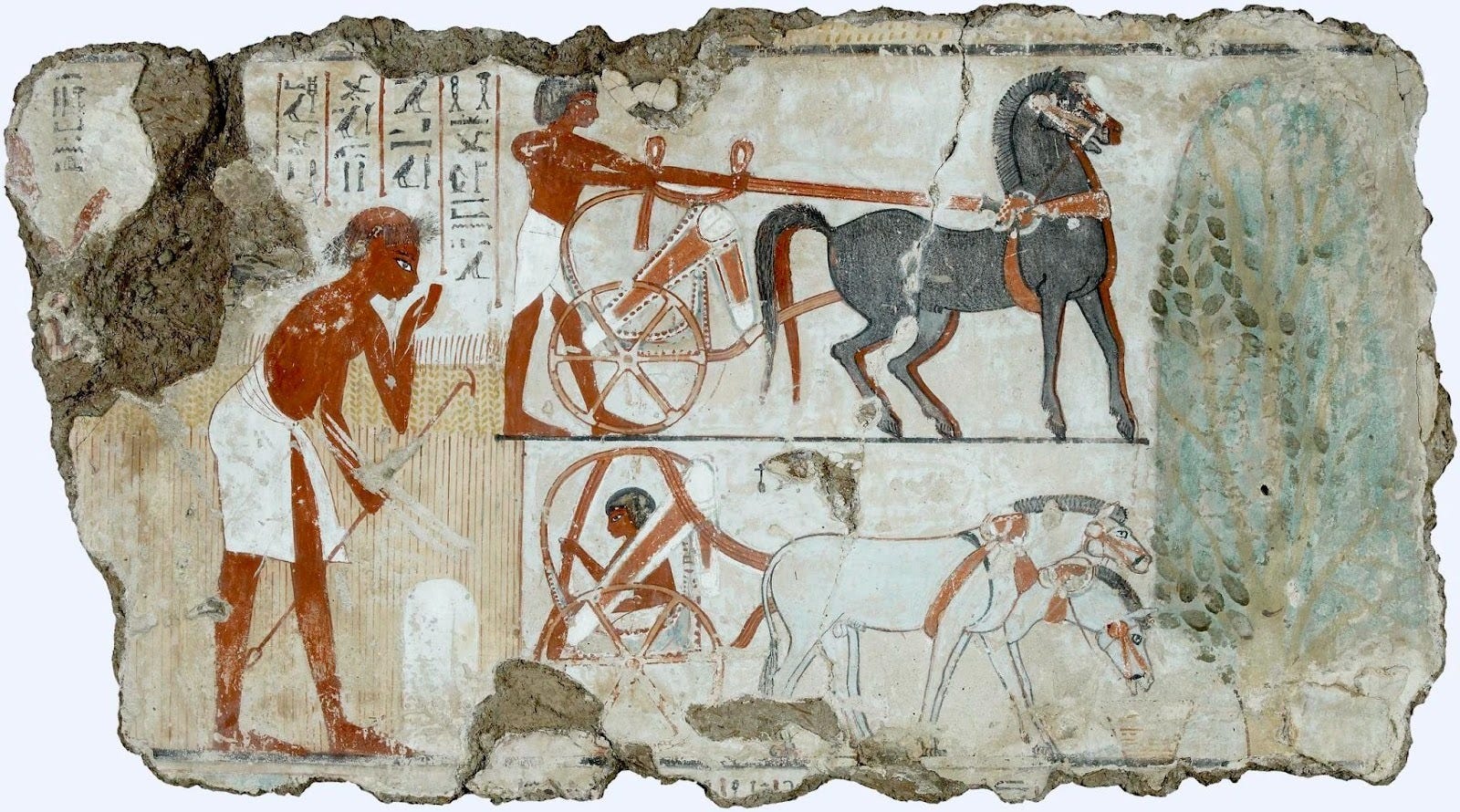
III: Painting from the Tomb of Nebamun at Thebes, showing horse and chariot.

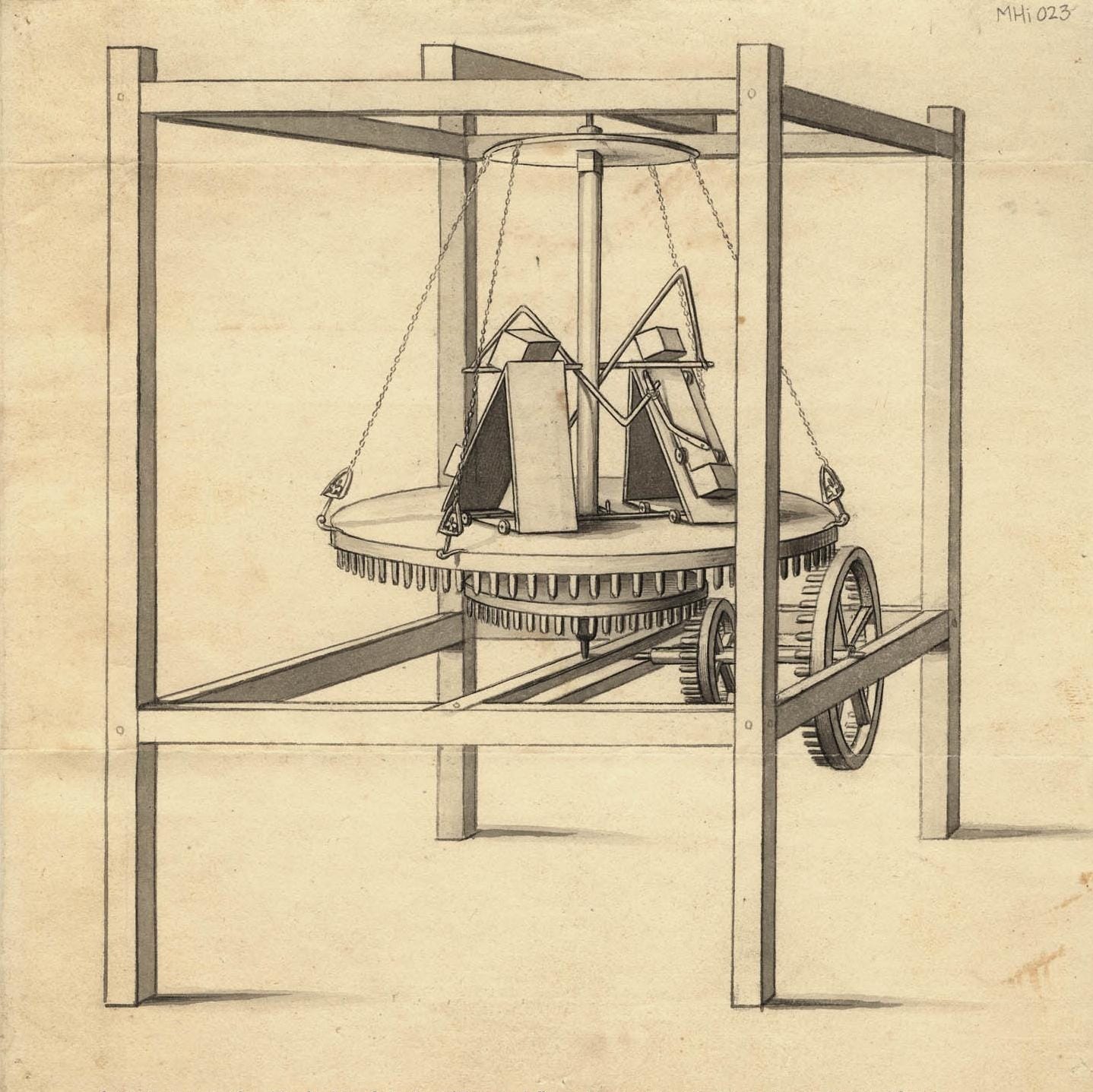
IV: A diagram showing the design of Charles Redheffer’s machine.

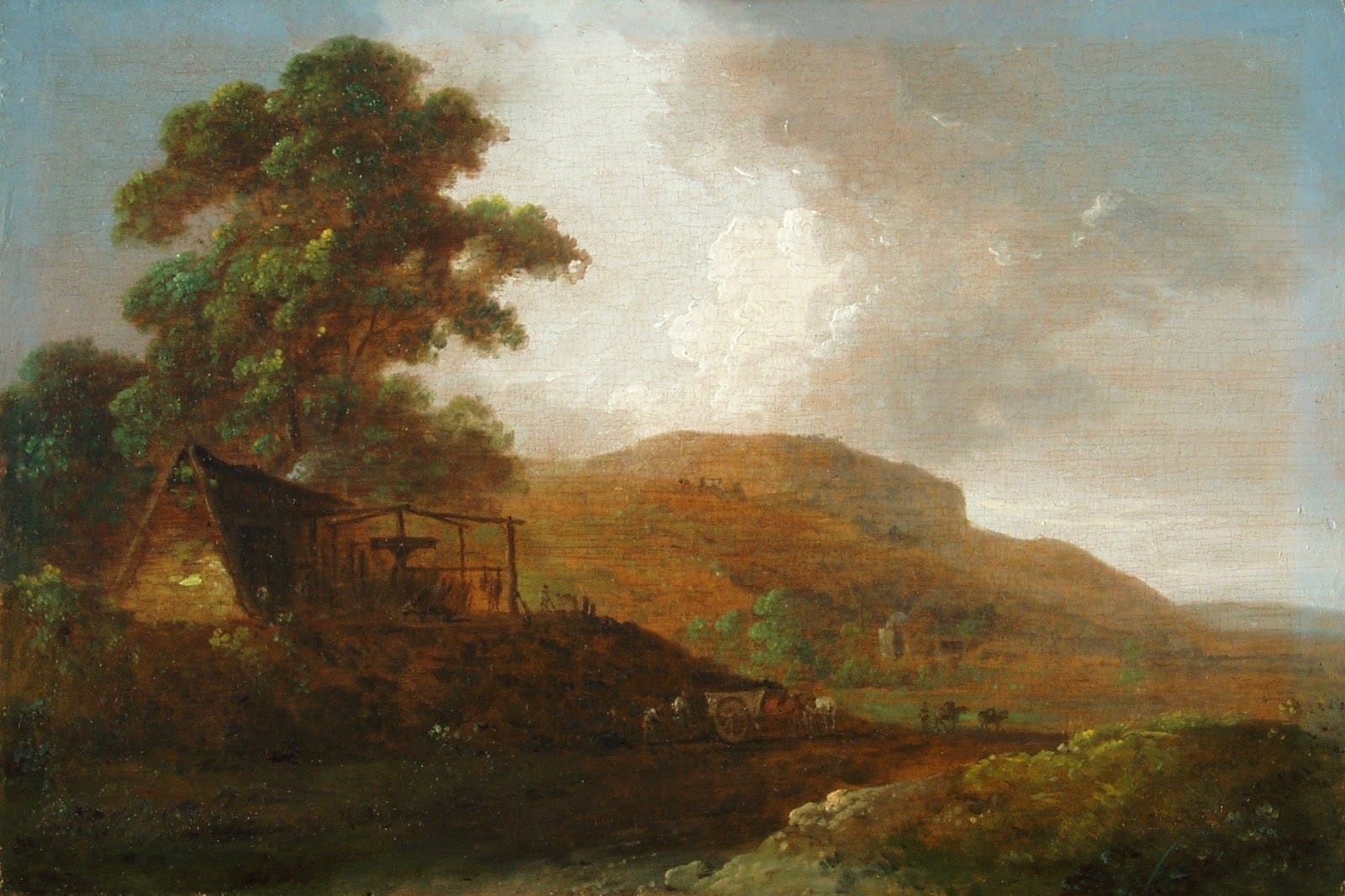
V: Welsh Landscape with Lead Mines by Thomas Jones.

VI: View of Earth taken during ISS Expedition 45.

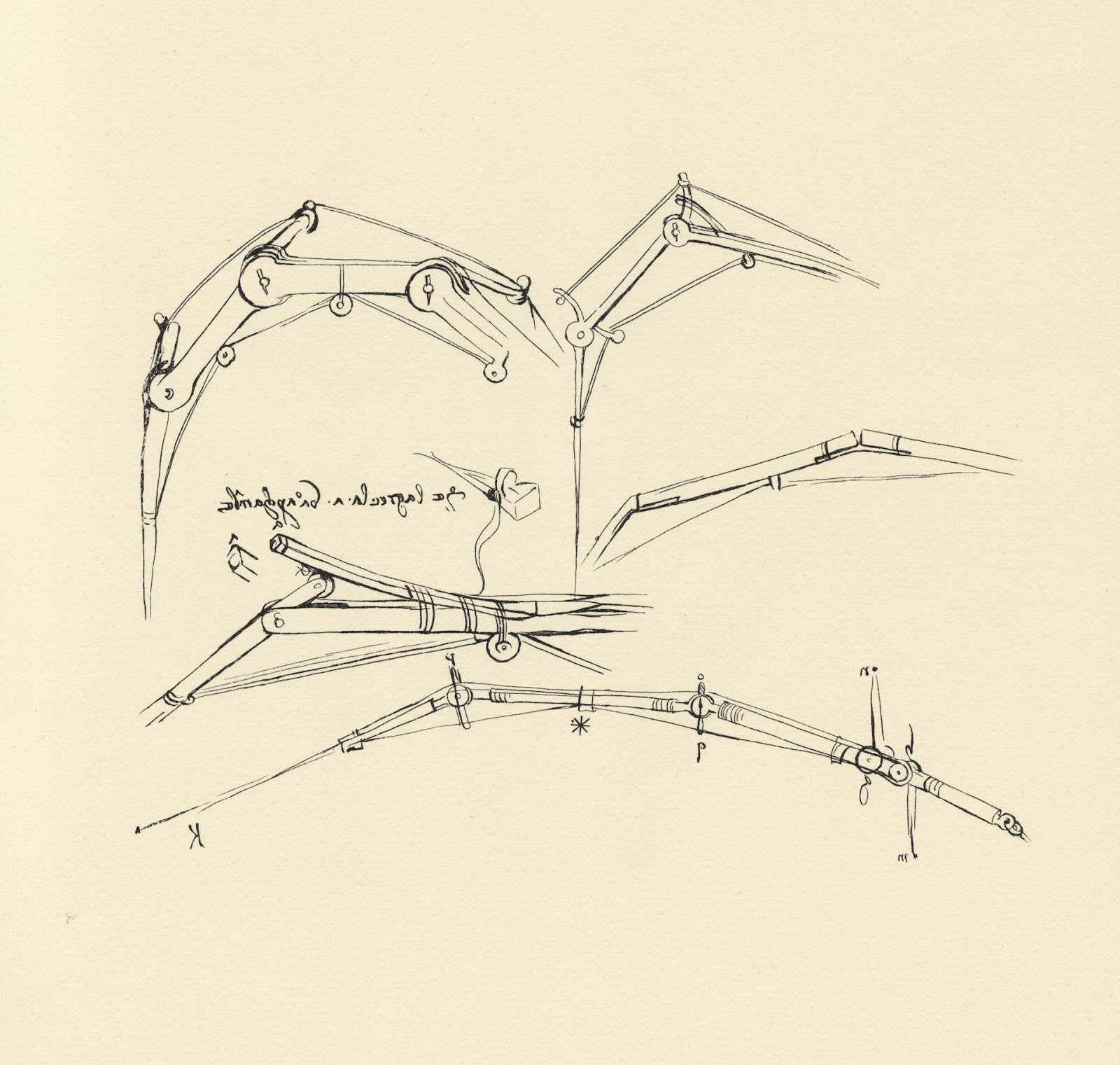
VII: Diagram of a proposed flying machine by Leonardo da Vinci.

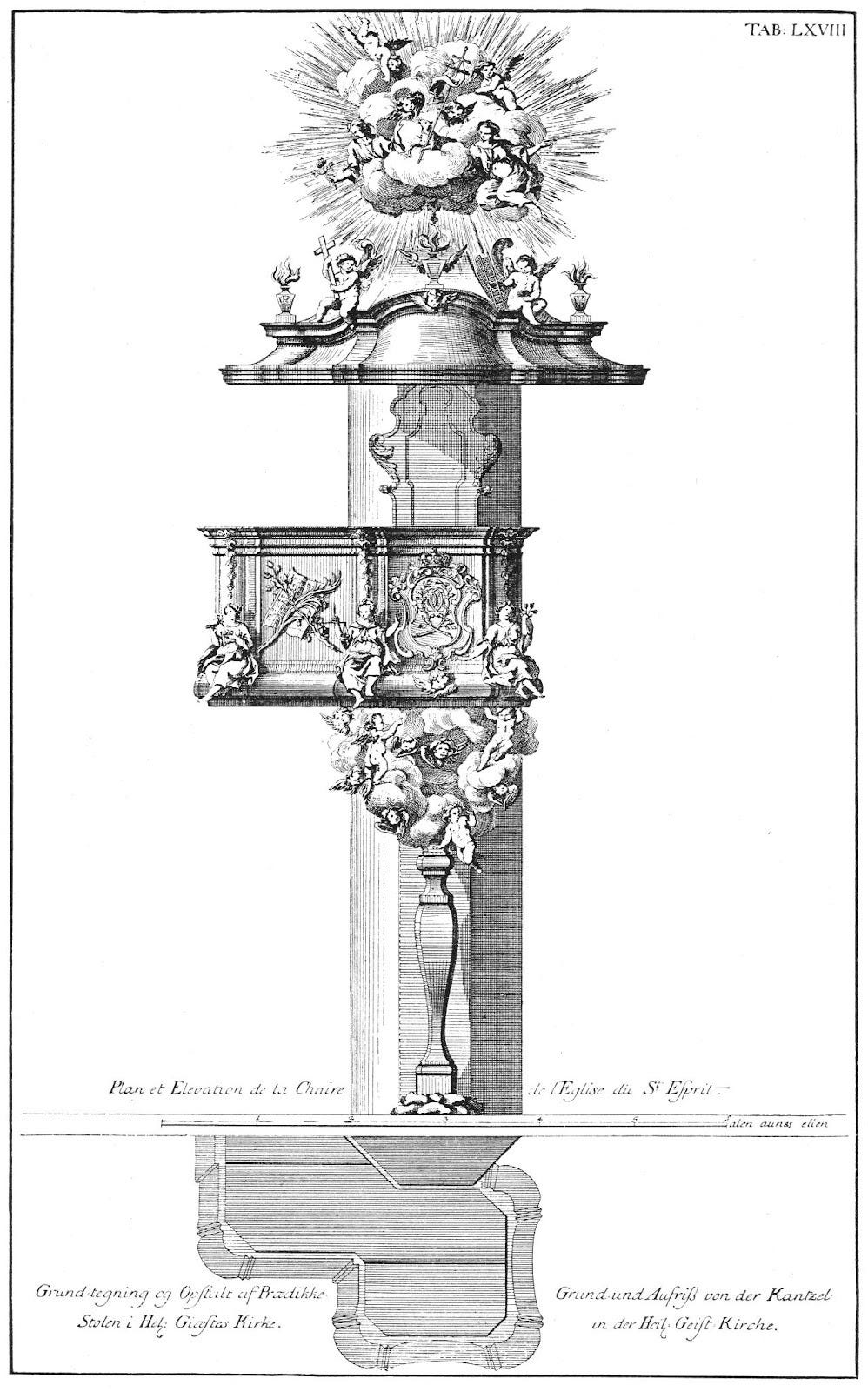
VIII: Drawing of pulpit by Ehbisch from Den Danske Vitruvius, 1746.

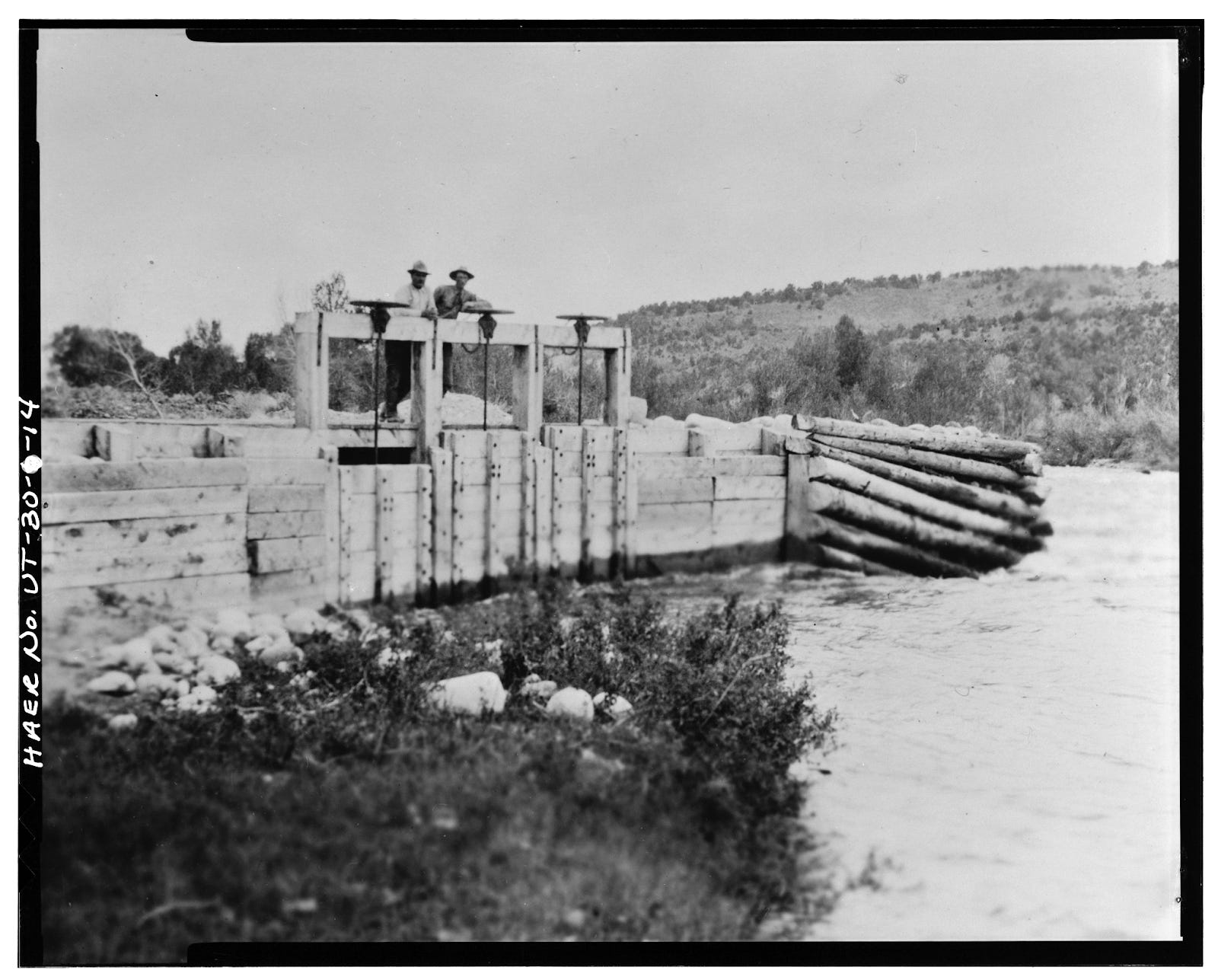
IX: Irrigation Canals in the Uinta Basin, Duchesne, Duchesne County, UT.


XII: Illustration from a 16th c. edition of Vitruvius, De Architectura by Andrea Palladio.


